Best Welding Projects for Beginners (And Cool Ideas for Every Skill Level)
From your first bead to Instagram-worthy builds: here are welding project ideas organized by skill level, with tips on materials and tools.
Starting With Sparks: Why Project-Based Learning Works
The fastest way to learn welding is to build something real. Running practice beads on scrap plate teaches technique, but nothing motivates progress like a finished project you can actually use. Whether you just bought your first welder or you have been laying beads for years, the right project pushes your skills without burying you in frustration.
The American Welding Society estimates there are over 400,000 hobbyist welders in the U.S., and that number has grown 25% since 2020, fueled by YouTube tutorials, affordable machines, and the Instagram fabrication community that turned metalwork into a visual art form.
Beginner Projects (First 0-6 Months)
If you are new to welding, start with mild steel, a MIG welder, and projects with forgiving joints. Flat-position butt joints and fillet welds are your bread and butter.
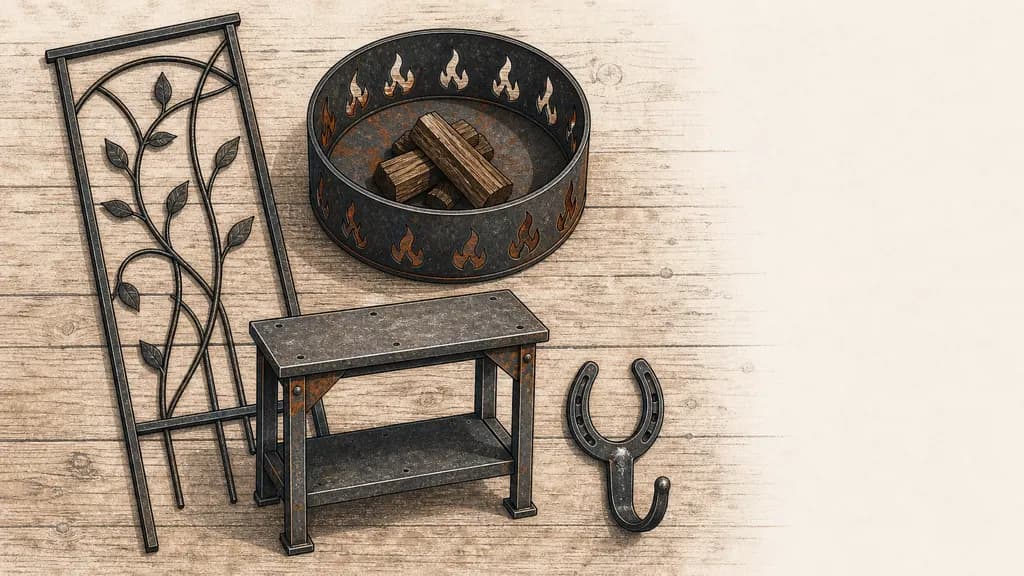
Fire pit. The classic first project. Cut steel plate or use an old propane tank, weld legs and a ring, and you have something functional. Cost: $40-$80 in material. Teaches: straight cuts, fillet welds, grinding.
Welding table. Build your own work surface from 2" square tubing and 3/8" plate or expanded metal. You will use this for every future project. Cost: $100-$200. Teaches: squareness, measuring, multi-pass fillet welds.
Tool rack or wall organizer. Flat steel bar, bent and welded into hooks and holders. Simple geometry, short welds, immediate utility. Cost: $20-$40. Teaches: tack welding, layout, light grinding.
Horseshoe projects. Bottle openers, coat hooks, trivets. Horseshoes are cheap, forgiving, and the rustic results look good even with imperfect welds. Cost: $10-$25. Teaches: welding odd shapes, dealing with rust and scale.
Trailer-hitch cargo carrier. Square tubing frame with expanded metal floor. Fits a standard 2" receiver. Functional and satisfying. Cost: $60-$120. Teaches: measuring to tolerance, structural fillet welds.
Intermediate Projects (6 Months - 2 Years)
Once your beads are consistent and you can weld in multiple positions, step up the complexity.
Steel workbench with drawers. Combine structural tubing with sheet metal. Introduces cutting accuracy, drawer slide mounting, and heavier fabrication. Cost: $200-$500.
Trailer build or rebuild. A small utility trailer from scratch teaches frame layout, axle mounting, wiring, and finish work. Or strip and rebuild a rusty trailer: you will learn more fixing someone else's bad welds than making your own. Cost: $500-$1,500 from scratch.
Custom gate. Design and build a garden gate or fence section. Introduces curves (if you have a bender), decorative elements, and hinge alignment. Cost: $150-$400.
Smoker or grill build. An offset smoker from pipe or an old tank is a classic intermediate project. Requires precise fitting, airtight seals, and heat management. The Instagram community lives for smoker builds: #weldedsmoker has over 200,000 posts. Cost: $200-$600.
Advanced Projects (2+ Years)
These require strong skills across multiple processes, tight tolerances, and often TIG welding.
Roll cage or tube chassis. Bending and notching chromoly tubing, fitting complex joints, TIG welding thin-wall tube. This is where fabrication meets engineering. Cost: $800-$3,000+ in materials.
Sculptural metalwork. If you follow accounts like @barfrench_, @theironfish, or @browndog_welding, you have seen what is possible when welding becomes an art form. Sculptural work demands control of heat, distortion, and finish in ways that push every skill you have.
Aluminum boat or jon boat mods. TIG welding aluminum is the deep end of the pool. Hull patches, transom reinforcement, and custom rod holders require AC TIG skills and proper filler selection (5356 for marine, always). Cost: varies widely.
Essential Gear for Project Welding
No matter your skill level, invest in safety and basic tooling:
- Auto-darkening helmet (spend at least $100: cheap helmets cause eye strain and bad welds)
- Leather welding gloves and a jacket or sleeves
- Angle grinder with cutting and flap discs
- Speed square, tape measure, soapstone markers
- Clamps, more than you think you need
- A MIG welder with 110v/220v capability covers most hobbyist projects. Budget $400-$800 for a reliable machine from Lincoln, Miller, or Hobart.
Share Your Work
The welding community on social media is one of the most supportive maker communities online. Post your projects, tag your welds, and do not be embarrassed by early work: every professional started with ugly beads. Follow hashtags like #weldporn, #fabricationlife, #mobilewelder, and #diywelding to find inspiration and honest feedback.
When your projects outgrow your skills or equipment, that is when a professional mobile welder earns their rate. Use WeldRunners to find a local pro who can tackle the jobs that need a certified hand.