Mobile Welding in Houston: Pipelines, Petrochemical, and Residential
Houston is the welding capital of America. The city that runs on oil, gas, and petrochemical infrastructure has more welders per capita than almost anywhere else, and the demand for mobile welding spans industrial plants, commercial construction, and residential neighborhoods across Harris County and beyond.
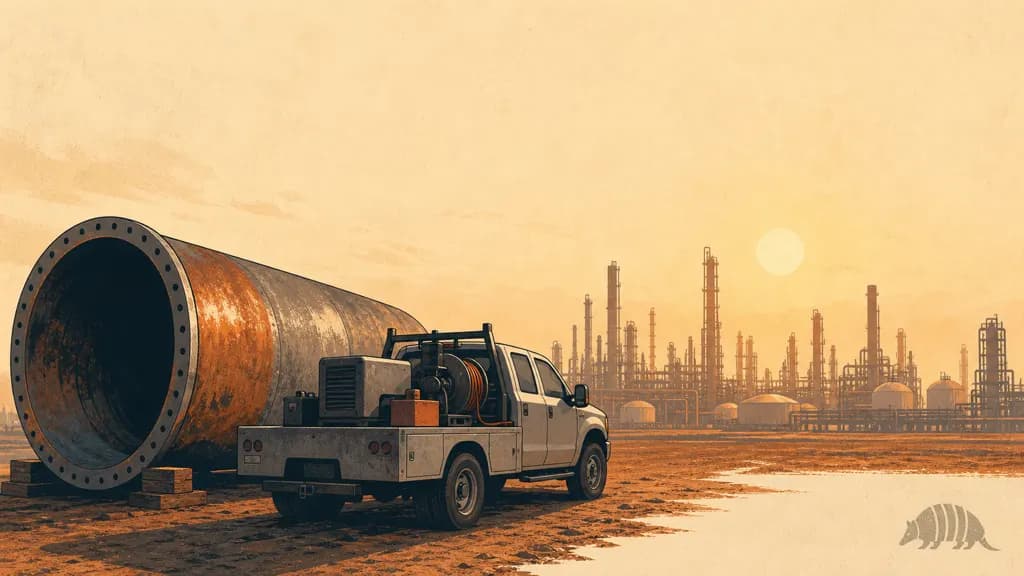
Houston: The Welding Capital of America
If any city deserves the title of welding capital, it is Houston. The greater Houston metro (encompassing Harris, Fort Bend, Montgomery, Brazoria, and Galveston Counties) is the undisputed hub of the American energy industry. The Houston Ship Channel alone hosts the largest petrochemical complex in the Western Hemisphere. ExxonMobil, Chevron Phillips, Shell, LyondellBasell, and dozens of other energy and chemical giants operate refineries, processing plants, and distribution terminals that stretch for miles along the channel.
This industrial concentration creates a welding culture unlike any other American city. Pipeline welding is not an obscure trade in Houston: it is a career path as familiar as law or accounting. The American Welding Society estimates that the Houston metropolitan area employs more welders per capita than any other major U.S. metro, and the region's community colleges, trade schools, and union apprenticeship programs produce a steady stream of certified welding professionals.
For mobile welders, Houston is both the biggest market and the most competitive. Here is how it breaks down.
Pipeline Welding: Houston's Signature Trade
Houston's pipeline welding culture is deep and storied. The network of oil, natural gas, refined product, and chemical pipelines that radiate from the Houston Ship Channel to the rest of the country represents tens of thousands of miles of welded steel pipe, and maintaining that network is a permanent, large-scale operation.
Mobile pipeline welders in Houston typically hold one or more of the following certifications:
- API 1104. The American Petroleum Institute standard for pipeline welding. API 1104 qualification is the baseline requirement for pipeline field welding. The test requires welding pipe joints in multiple positions (2G, 5G, 6G) with destructive testing (nick-break, guided bend, and sometimes tensile testing) of the completed welds.
- ASME Section IX. Required for pressure piping work in refineries and processing plants. ASME Section IX qualification is employer-specific and must be maintained through periodic retesting.
- ASME B31.3. The Process Piping code, governing welding on piping systems in chemical plants, refineries, and pharmaceutical facilities. Welders working inside the fence at Houston-area plants must be qualified under B31.3 through their employer or the plant operator's welding program.
Pipeline welding in Houston pays well: $35-$75/hour as an employee, and substantially more for independent rig welders who own their own trucks and equipment. A fully equipped pipeline welding rig in Houston represents a $60,000-$120,000 investment in truck, welder, tools, and certifications.
Common pipeline and industrial mobile welding jobs include:
- Pipeline tie-ins, hot taps, and repair sleeve installations
- Pipe rack structural steel repair and modification
- Vessel nozzle and shell repairs (ASME code work)
- Tank farm maintenance: storage tank shell, roof, and floor plate welding per API 650
- Pipe support and structural steel repairs at plant facilities
- Emergency pipeline leak repairs
Petrochemical Plant Maintenance
Houston's petrochemical plants run around the clock, 365 days a year, and they conduct major maintenance events called "turnarounds" on a scheduled basis (typically every 3-5 years per unit). During a turnaround, sections of the plant are shut down for intensive maintenance, repair, and upgrade work that can involve hundreds of welders working simultaneously for weeks.
Mobile welders who serve the turnaround market in Houston need:
- Current ASME Section IX and/or ASME B31.3 qualifications
- OSHA 10-hour or 30-hour construction safety certification
- TWIC (Transportation Worker Identification Credential) card for access to maritime facilities
- Site-specific safety orientations (each plant has its own)
- Drug testing and background screening compliance
Between turnarounds, plants require ongoing mobile welding for:
- Emergency repairs on piping, vessels, and structural steel
- Modification work for process changes and capacity expansions
- Scaffolding bracket and platform fabrication
- Safety barrier and guardrail installation and repair
The Houston chapter of the National Association of Corrosion Engineers (NACE, now AMPP, the Association for Materials Protection and Performance) is highly active in the region, and many industrial welders in Houston also hold NACE coating inspector or corrosion technician certifications that complement their welding credentials.
Commercial and Residential Mobile Welding
Beyond the industrial sector, Houston's sheer size (the metro population exceeds 7 million) generates massive demand for commercial and residential mobile welding:
Commercial welding. Houston's commercial construction market is the largest in Texas. Office buildings, retail centers, warehouses, restaurants, and medical facilities all require welding during construction and ongoing maintenance:
- Structural steel connections and modifications
- Handrail and guardrail fabrication and installation
- Bollard and security barrier installation
- Dumpster enclosure frames and gates
- Equipment pad and platform fabrication
- Parking garage structural repair
Residential welding. Houston's residential neighborhoods span every style and era, from River Oaks estates with ornamental iron gates to suburban communities in Katy, Sugar Land, and Pearland where driveway gates and patio covers are standard features:
- Driveway gate fabrication and repair. Wrought-iron and tubular steel driveway gates are ubiquitous in Houston's suburban neighborhoods. Gate fabrication is one of the highest-volume residential mobile welding jobs in the metro. A custom driveway gate with automatic opener typically runs $2,500-$8,000 installed.
- Fence repair. Steel and iron fences corrode in Houston's humid, salt-tinged air (proximity to the Gulf of Mexico accelerates corrosion in the southern portions of the metro). Fence post repair, panel reattachment, and section replacement are weekly calls for residential mobile welders.
- Patio cover and carport construction. Steel-frame patio covers and carports are popular in Houston for protection from sun and rain. Fabrication and installation of these structures is a steady revenue stream for mobile welders.
- Trailer repair. Houston's proximity to ranching country and its role as a logistics hub mean trailers are everywhere. Stock trailers, utility trailers, boat trailers, and flatbeds all need regular welding maintenance.
Houston's Humidity: The Corrosion Factor
Houston's average annual humidity hovers around 75%, and the metro's proximity to the Gulf of Mexico means salt-laden moisture is a constant presence, particularly in communities south and east of downtown. This humidity creates a corrosion environment that directly impacts mobile welding:
- Surface prep is critical. Welding on corroded metal without proper cleaning produces weak, contaminated welds. Houston mobile welders spend significant time grinding, wire brushing, and chemically treating rust before welding.
- Low-hydrogen electrodes. Humidity causes standard welding electrodes to absorb moisture, which introduces hydrogen into the weld and causes cracking. Professional Houston welders store electrodes in heated rod ovens and use vacuum-sealed packaging to prevent moisture absorption.
- Post-weld protection. Bare steel welds in Houston's environment will develop surface rust within days. Applying primer, paint, or galvanizing immediately after welding is essential for durability. Many Houston mobile welders offer field priming as a standard part of their service.
Texas Licensing for Houston Welders
Texas licensing requirements for Houston-area mobile welders mirror the DFW market:
- No state welding license. Texas does not require a separate welding license. However, welders performing structural work on buildings or infrastructure typically work under a licensed contractor.
- City of Houston permits. The City of Houston requires building permits for structural modifications, fence installation over certain heights, and new construction. The Harris County building department has similar requirements for unincorporated areas.
- TDLR oversight. The Texas Department of Licensing and Regulation oversees contractor licensing for certain scopes of work.
- Industrial credentials. For refinery and plant work, the combination of ASME, API, OSHA, and TWIC credentials effectively functions as a licensing system, even though no single state license covers the scope.
What Mobile Welding Costs in Houston
Houston's large pool of qualified welders keeps residential and commercial pricing competitive, while industrial rates reflect the certifications and site access requirements involved:
- Hourly rates: $80-$135/hour for general mobile welding; $120-$200/hour for certified structural or pipe work; $150-$250/hour for ASME/API-qualified industrial work
- Service call minimums: $175-$300 for residential/commercial; $300-$500+ for industrial site work
- Common job ranges: Gate repair $200-$500; gate fabrication and install $2,000-$8,000; fence repair $200-$600; trailer repair $250-$700; patio cover fabrication $1,500-$5,000; structural steel $500-$2,500+; industrial pipe welding $500-$5,000+ per job
Houston's sprawl is extreme: it is 50 miles from Katy to Baytown. Trip charges vary significantly based on the welder's base location relative to your job site.
Finding a WeldRunners in Houston
Houston has more mobile welders than almost any other city, but the quality range is wide. For residential work, look for insurance, portfolio photos, and reviews. For industrial work, verify certifications (API 1104, ASME Section IX, OSHA, TWIC) and confirm the welder has experience with your specific type of facility.
WeldRunners connects you with mobile welders across the entire Houston metro, from The Woodlands to Galveston, Katy to Baytown. Search by location and specialty, verify credentials, and find a professional who knows the Houston market. In the welding capital of America, there is no shortage of talent: the key is matching the right welder to your job.