Mobile Welding in Seattle: Marine, Tech Campus, and Residential Repair
Seattle and the Puget Sound region have a unique mobile welding market shaped by marine industry, tech campus infrastructure, and a residential building stock that ranges from 1920s Craftsman to modern steel-frame. Here is the guide.
The Pacific Northwest Welding Market
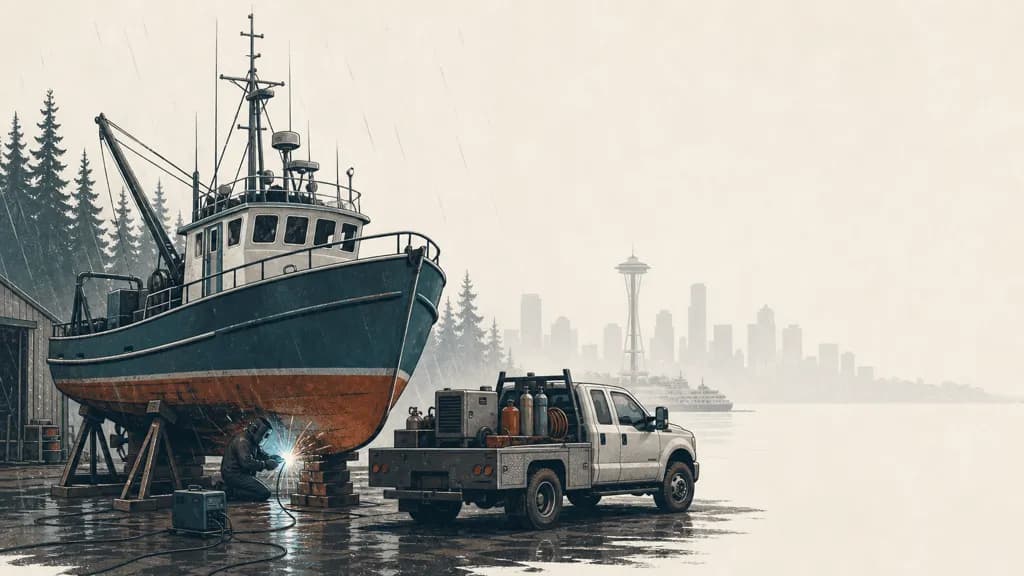
The Seattle metropolitan area (spanning King, Snohomish, and Pierce Counties from Everett to Tacoma) sits where marine industry, technology, aerospace, and a residential market all converge in ways no other region quite matches. With Puget Sound on one side and the Cascade Range on the other, a mobile welder here might repair a commercial fishing vessel in the morning, fix a handrail at a tech campus in Redmond at midday, and weld a cracked gate hinge on a Capitol Hill Craftsman home before dinner.
The Pacific Northwest's relationship with water, weather, and industry creates a mobile welding demand profile that is distinct from any other major U.S. metro.
Marine and Boat Welding: The PNW Specialty
Marine welding is the signature specialty of the Seattle-area mobile welding market. Puget Sound, the San Juan Islands, Lake Washington, Lake Union, and the network of rivers and canals that run through the metro area support a massive recreational and commercial boating industry.
The Port of Seattle, the Fishermen's Terminal in Ballard, and the marinas from Shilshole to Des Moines house thousands of commercial fishing vessels, tugboats, ferries, and recreational boats, all of which need welding services that are best delivered dockside rather than in a drydock fabrication shop.
Common marine mobile welding jobs in the Seattle area include:
- Aluminum hull repair. The Pacific Northwest fishing fleet relies heavily on aluminum-hulled vessels. Corrosion pitting, impact damage, and fatigue cracking in hull plates require skilled aluminum TIG welding, often performed at the dock or on a marine railway. AWS D3.6 (Underwater Welding Code) may apply for certain below-waterline repairs, though most mobile welders work above the waterline.
- Steel barge and tug repairs. The Puget Sound commercial fleet includes steel-hulled barges, tugboats, and workboats. Structural steel repair, deck plate replacement, and cleat and bollard welding are standard mobile jobs.
- Dock and pier structural repair. Steel and aluminum docks, gangways, and float systems sustain corrosion and storm damage. Mobile welders who serve marinas keep these structures safe and functional.
- Davit, crane, and rigging hardware repair. Commercial vessels use steel and aluminum lifting equipment that requires periodic welding maintenance.
- Custom marine fabrication. Rod holders, radar mounts, swim platforms, anchor rollers, and fish cleaning stations: all commonly fabricated on-site by mobile welders who serve the boating community.
Aluminum welding skill is particularly critical in the Seattle market. A welder who can produce clean, code-quality aluminum TIG welds is in high demand and can charge a premium. AWS D1.2 (Structural Welding Code — Aluminum) certification is a significant differentiator for marine-focused mobile welders in the PNW.
Tech Campus and Commercial Maintenance
The Seattle metro is headquarters to some of the largest technology companies in the world. Amazon's sprawling campus in South Lake Union, Microsoft's Redmond campus, Meta's facilities in Bellevue, Google's Kirkland and Seattle offices, and dozens of other tech campuses generate steady demand for maintenance welding.
Tech campus welding work includes:
- Handrail and guardrail repair and installation. Large campuses with parking structures, pedestrian bridges, and multi-level buildings require code-compliant metal railings. Stainless steel cable railing systems, a design favorite in Pacific Northwest architecture, require skilled TIG welding and precise layout.
- Bollard and barrier installation. Vehicle barriers, bike rack posts, and security bollards are frequently installed and modified on commercial campuses.
- Equipment pad and platform fabrication. HVAC equipment, backup generators, and server room infrastructure often require custom steel platforms, frames, and support structures welded on-site.
- Architectural metalwork. The tech industry's emphasis on design extends to its physical spaces. Custom steel and aluminum features (canopies, screening, decorative elements) are often fabricated and installed by mobile welders working with architects and general contractors.
- Facility modification. As tech companies reconfigure workspaces, mobile welders are called to modify structural steel, cut new openings, and reinforce floors for heavy equipment.
Residential Welding in Seattle
Seattle's residential building stock spans more than a century, from early 1900s Craftsman bungalows in Wallingford and Ballard to mid-century modern homes in the Eastside suburbs to contemporary steel-and-glass construction in Bellevue and Kirkland. Each era presents different welding needs:
- Wrought-iron and steel railing repair. Older Seattle homes and apartment buildings feature original iron railings, fire escapes, and decorative metalwork. Corrosion is the primary enemy, accelerated by Seattle's year-round moisture. Repair work ranges from spot-welding cracked connections to fabricating replacement sections that match existing profiles.
- Gate and fence work. Steel and aluminum fences, driveway gates, and garden gates are common throughout Seattle's residential neighborhoods. The city's hilly terrain creates unique installation challenges: gates on sloped driveways require custom hinge geometry and arc-shaped bottom rails to clear the grade change.
- Deck and structural steel. Modern residential construction in Seattle increasingly uses structural steel beams, columns, and moment frames for earthquake resistance. The Puget Sound region is seismically active, and the Seattle Building Code (based on the International Building Code with local amendments) has strict requirements for structural steel welding, including mandatory special inspection by a qualified testing agency.
- Retaining wall and erosion control. Seattle's steep terrain and wet climate create hillside stability challenges. Steel sheet piling, soldier pile walls, and structural steel tiebacks are common engineering solutions that require field welding.
Washington State Licensing and Regulations
Washington has a relatively structured regulatory environment for contractors, administered by the Washington State Department of Labor and Industries (L&I):
- Contractor registration. Washington requires all contractors to register with L&I and obtain a Washington State contractor's license (UBI number). Mobile welders who perform work on buildings or structures must be registered as contractors. Operating without registration carries penalties up to $5,000 per infraction and makes any contract unenforceable.
- Bonding and insurance. Washington requires registered contractors to post a surety bond ($12,000 minimum for general contractors) and carry liability insurance. This provides customer protection that is stronger than many other states.
- Specialty contractor designations. While L&I does not have a specific "welding" contractor classification, mobile welders typically register under general contractor, specialty contractor, or industrial/commercial contractor categories depending on their scope of work.
- Prevailing wage. Welding work on public projects in Washington (schools, government buildings, infrastructure) is subject to prevailing wage requirements, which set minimum hourly rates significantly above private-sector norms.
- The Puget Sound Section of AWS. Hosts regular certification testing events in the Seattle area and provides continuing education for welding professionals.
What Mobile Welding Costs in Seattle
The Seattle market reflects the region's higher cost of living and strong labor market:
- Hourly rates: $95-$155/hour for general mobile welding; $140-$225/hour for certified structural, marine aluminum, or specialty work
- Service call minimums: $200-$350
- Common job ranges: Railing repair $300-$800; gate repair and fabrication $250-$1,500; marine aluminum welding $400-$1,500+; structural steel $600-$3,000+; tech campus maintenance $300-$1,200
Seattle's traffic congestion and water barriers (bridges, ferries) make travel time a significant cost factor. A welder in Tacoma quoted for a job on Bainbridge Island is planning for ferry schedules in addition to drive time. Hire local when possible.
Finding a WeldRunners in Seattle
The Puget Sound region's unique combination of marine work, commercial construction, and residential diversity means that specialization matters more here than in most markets. A marine aluminum welder and a structural steel welder are very different professionals: make sure the welder you hire matches your job.
WeldRunners lists mobile welders across the greater Seattle area, from Everett to Tacoma, Bellevue to Bremerton. Filter by published specialty, review the profile, and contact providers directly. Check current L&I registration and ask for job-specific references before hiring.