Mobile Welding vs Shop Welding: Cost, Speed, and When Each Makes Sense
Mobile welders come to you, shop welders make you come to them. Here's the honest breakdown of cost, speed, and quality so you can pick the right one.
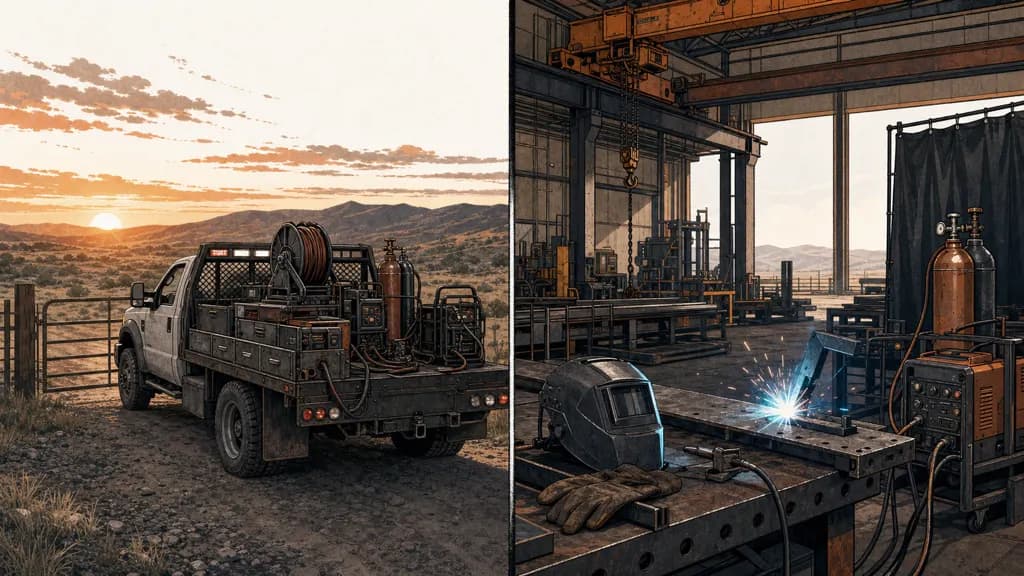
Here's the question nobody wants to ask out loud before they call a welder: am I even calling the right kind of welder?
Mobile welders come to you. Shop welders make you come to them. Both are legitimate. Both can do beautiful work. They are not interchangeable, and picking the wrong one can cost you a full day, a tow bill, or a repair that fails six months later because the fix didn't suit the job.
Let's go through this honestly: what each is good at, what each is bad at, and how to tell which one you actually need.
The Quick Verdict
Call a mobile welder when:
- The thing you need welded is heavy, fixed, or dangerous to move (heavy equipment, farm gates, structural steel, trailers with broken axles, fuel tanks, in-place handrails).
- You need a repair finished the same day and downtime is costing you money.
- The job site is remote, active, or has no easy way to load and unload the piece.
- You only need a field repair, not a restoration.
Take it to a shop when:
- The piece is portable (gates, brackets, small trailers you can haul yourself, custom fab projects, parts under a few hundred pounds).
- You need precision work: TIG on thin aluminum, stainless sanitary welds, pressure vessels, art fabrication.
- The finished job needs sandblasting, powder coating, or painting.
- You need a big layout area, jigs, or machinery the field doesn't support (press brakes, plasma tables, CNC, large fab tables).
Now the detail.
Cost: What You Actually Pay
The honest comparison looks like this.
Mobile welder pricing. Most solo mobile welders charge $75 to $150 an hour, with $95 to $125 being the common working range. On top of the hourly, expect a trip fee (sometimes called a truck fee or mobilization fee) of $75 to $250 depending on distance. Some welders bill a flat minimum: often 1 to 2 hours regardless of how small the job is. Emergency or after-hours work runs 1.5x to 2x the standard rate.
Shop welder pricing. Shops usually charge $60 to $100 an hour for labor. No trip fee. But you're paying for transport on your end: either your own time and fuel hauling the piece there and back, or a tow bill if it's too big to move yourself. Shops also often have a bench minimum of half an hour and charge for consumables and materials separately.
The real comparison. For a small portable job (a broken trailer hitch, a cracked bracket, a gate you can throw in a truck) the shop almost always wins on total cost. You pay $60 to $100 an hour, no trip fee, and you're only out gas and thirty minutes of driving.
For anything bolted down, fixed in place, or too heavy to move without a trailer and a forklift, mobile wins before you finish reading this sentence. Paying a mobile welder $350 for two hours at the farm is cheaper than renting a flatbed trailer, hauling the gate forty miles to a shop, and making a second trip to bring it back.
Where it gets interesting is the middle: a job you could move, but reluctantly. A 500-pound fabricated piece. A trailer that technically still rolls but has a sketchy axle. The cost depends on your time, your equipment, and whether moving the thing risks making the damage worse.
Speed: What Costs You a Day
People underestimate how long shop jobs actually take from start to finish.
A shop job is almost never "drop it off, pick it up in an hour." Most shops work on a queue. You drop it off Monday, they get to it Wednesday, they call you Thursday, you pick up Friday. That's four days of downtime on whatever that piece was part of. For a homeowner who can live without the garden cart for a week, that's fine. For a contractor whose skid steer bucket cracked on a Tuesday morning, that's $4,000 in lost billables.
A mobile welder, if they have an opening, often shows up the same day or the next morning. They assess, fix, and leave. The piece never stops being in service. For anything attached to an active jobsite (heavy equipment, trailers, truck frames, fence posts, ranch gates) the calculus is almost always "pay the trip fee, save the day."
That said: mobile welders get booked. Emergency work bumps routine work. If you call Monday for a non-urgent fab job, you might wait until Thursday anyway. Speed advantages only apply when the job actually needs speed.
Quality: Where the Tradeoff Gets Real
This is the part most comparison articles skip.
A shop beats the field on precision work. If you need TIG welds on thin aluminum, a clean weld on a stainless food-grade handrail, a welded pressure vessel, or anything cosmetic, take it to a shop. Shops have temperature control, clean air, proper fixturing, and the ability to grind, blast, and finish the piece after the weld. A good shop welder doing TIG in a climate-controlled room with a proper workholding jig will produce a better weld than the same welder doing the same job under a tarp in a 30 mph wind.
A mobile welder beats the shop on repair welds and field steel. Stick welding (SMAW) is the workhorse of mobile welding for a reason: it cuts through mill scale, surface rust, and a little bit of paint. Good mobile welders are expert at Stick and at flux-cored welding, both of which handle dirty, outdoor, imperfect conditions. A field-repair weld on a 3/8-inch gate post is not supposed to look like jewelry. It's supposed to hold cattle for another twenty years. Mobile welders are trained to deliver exactly that.
The failure case is when people ask for the wrong process from the wrong setting. A mobile welder doing TIG on thin aluminum outdoors in wind will produce a worse weld than a shop would. A shop welder doing Stick on a rusty gate after the customer hauled it across four counties will still be fighting contamination the mobile welder would never have seen, because the gate was never torn apart in the first place.
Ask what you actually need. Then pick the environment that suits it.
Real Examples
Skid steer bucket cracked at 9am on a jobsite. Mobile welder wins. Trip fee plus two hours of labor gets it welded by lunch. Moving the bucket means renting a trailer, breaking down the jobsite, and losing a day minimum.
Custom fabricated weld-in sub-frame for a classic truck restoration. Shop wins. Needs a jig, a layout table, measurements to a 16th, and probably sandblasting and paint after. A shop is built for this. A mobile welder doing it in your driveway will take longer and cost more.
Ranch gate hinge torn off the post. Mobile welder wins. Post is set in concrete. Taking it to a shop means cutting the post out (ruining it), hauling the rest, and resetting concrete when you get home. Mobile welder shows up with a torch, straightens the post, and welds a new hinge in two hours.
Decorative stainless handrail for a commercial kitchen. Shop wins. TIG on stainless needs clean air, argon shielding, and often a back purge. A shop has all of that. A mobile welder working outside won't produce a food-grade finish no matter how skilled they are.
Trailer axle snapped on the side of the highway. Depends. If the trailer can be towed to a shop safely, the shop is cheaper. If it can't, mobile wins: a mobile welder can stabilize or fully repair the axle in place. The worst mistake here is trying to save money by hauling a broken axle down the highway and making it worse.
Structural steel repair on an existing building. Mobile only. The steel isn't coming to a shop. Find a welder certified to AWS D1.1 (or whatever your local code requires) and confirm they can produce the inspection paperwork before they start.
How to Decide in 60 Seconds
Ask three questions.
- Can I reasonably move it myself? If moving it requires a trailer rental, a tow truck, or serious risk to the piece, go mobile.
- Does it need to look or function like new? If yes, shop. If it just needs to hold, go mobile.
- Is downtime costing me money? If you're losing billables every day the piece is out of service, the mobile welder's trip fee is almost always cheaper than a shop's queue time.
Two yeses toward mobile? Call a mobile welder. Two yeses toward shop? Drop it off.
Frequently Asked Questions
Is it cheaper to use a mobile welder or take the job to a shop?
It depends entirely on what needs moving. For small, portable pieces (brackets, hitches, gates you can throw in the back of a truck) a shop is almost always cheaper because you skip the mobile welder's trip fee and hourly rates run $20 to $40 lower. For anything bolted down, too heavy to safely transport, or attached to a jobsite, a mobile welder is cheaper once you factor in trailer rental, tow fees, disassembly time, and downtime. A mobile welder's typical $75 to $150 hourly plus a $75 to $250 trip fee sounds like a lot until you price out renting a flatbed and hauling a skid steer bucket across a county. Run the full math before you decide, including your own time at whatever that's worth.
How much does a mobile welder cost per hour in 2026?
Most solo mobile welders in the U.S. charge between $75 and $150 an hour, with $95 to $125 being the most common working range for general repair and fabrication work. Pipeline and specialty structural welders charge more: $150 to $250 an hour is normal for certified work on inspected joints. On top of the hourly, expect a trip fee between $75 and $250 depending on distance from the welder's base. Emergency calls, weekends, and after-hours work typically run 1.5x to 2x the standard rate. Rural areas sometimes see lower rates because the cost of living is lower, but trip fees tend to be higher because the drives are longer. Always get the full quote (hourly, trip fee, minimum, and whether consumables are extra) before the welder rolls.
What kinds of jobs should I never call a mobile welder for?
Three categories. First, precision TIG work on thin stainless or aluminum: commercial kitchen handrails, food-grade piping, decorative metalwork. That work needs a controlled environment and is usually better in a shop. Second, custom fabrication projects that require layout tables, press brakes, plasma-cutting tables, or CNC work. A mobile welder is a fabrication shop compressed into a truck, but it's not a full fab shop. Third, anything requiring sandblasting, powder coating, or paint as part of the finished product. Mobile welders typically don't offer those services and sending a rough-welded piece to a separate finisher usually costs more than starting at a shop that does everything under one roof. If the job involves any of those three, get a shop quote first.
Will a mobile welder's work be as strong as a shop's?
For the kind of work mobile welders specialize in (field repairs, structural patches, farm and heavy equipment work) yes, a good mobile welder's weld is every bit as strong as the same weld made in a shop. Stick and flux-cored processes, which dominate mobile work, are specifically designed to produce sound welds in outdoor, dirty, imperfect conditions. Where a mobile weld can fall short is in applications that demand shielded TIG or specialty processes that don't tolerate wind, contamination, or temperature swings. For those, shop conditions actually matter. A rule of thumb: for structural integrity, process selection matters more than location. For cosmetic finish, location matters more than process.
How do I know if a mobile welder is qualified for structural or code work?
Ask for certifications specific to the job. AWS D1.1 covers structural steel. AWS D1.2 covers aluminum. API 1104 covers pipeline. ASME Section IX covers pressure vessels. A qualified welder will have the paper and won't be defensive about showing it. For inspected work (anything that will go through a building inspector, municipal engineer, or insurance review) confirm the welder can produce procedure qualification records (PQRs) and welder performance qualifications (WPQs) matching the job specs. If a welder tells you certifications "don't really matter" for inspected work, find another welder. On repair and farm work that isn't inspected, skill and references matter more than paper: ask for photos of past jobs and two customer references, and call them.