What's Inside a $50,000 Mobile Welding Rig? Full Truck Tour & Equipment Breakdown
A real working $50K mobile welding rig, broken down piece by piece: truck, welder, cutting gear, tools, and the upgrades that actually pay for themselves.
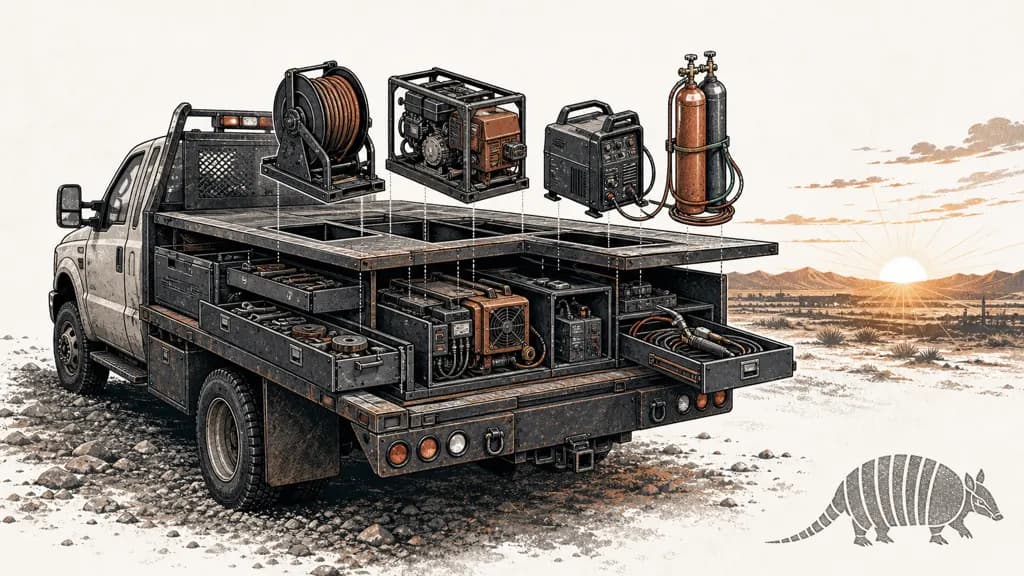
It's 6:15 on a Tuesday morning and your phone buzzes. A rancher forty minutes south has a cattle gate that got clipped by a delivery truck. The hinge side is torn off the post. He has 200 head that need to move through that gate by noon.
He doesn't ask you to bring the gate to a shop. That's the whole point of what you do.
You pull on boots, grab a coffee, and you're rolling by 6:30. Everything you need is already behind you: welder, torch, grinder, clamps, consumables. No second trip. No calling a buddy to bring a generator. The truck IS the shop.
Most people see a mobile welder's rig and think "guy with a welder in the back." That's like calling a surgery suite "a room with some knives." A properly built rig is a fabrication shop on wheels, and every inch of it is doing a job.
Let's walk through one. Not a fantasy build. A real, working $50K setup a solo operator could drive to a ranch gate at 7am and a structural repair by noon.
The Truck
You want a 3/4-ton minimum. F-250 or Ram 2500. A 1-ton (F-350, 3500) is better if you're running a flatbed, which you should be.
Why flatbed over a pickup bed? Two reasons. First, you can mount toolboxes on both sides without losing bed space. Second (and this is the real move) you leave a 4x7-foot open area on the deck that doubles as a fab table. You're cutting and fitting steel right on the truck. No sawhorses. No improvising on the tailgate. The truck IS your shop.
A decent used F-350 flatbed runs $20,000 to $30,000 depending on mileage and how honest the seller is. That's your single biggest line item and the thing you should not skimp on. A truck that won't start is not a mobile welding business.
The Welder
This is the heart of the rig. You need an engine-driven welder-generator combo. Not a little inverter you plug in at home. This thing makes its own power.
The Miller Trailblazer 330 EFI is hard to beat for a solo operator. 330 amps, 12,000-watt generator, and it only weighs 400 pounds. That generator output matters: it runs your grinder, your lights, your plasma cutter, all off the one machine.
If you have the budget, the Lincoln Vantage series (300, 400, or 500) or a Miller Big Blue gives you more headroom. A new Big Blue runs $25,000 to $48,000 depending on the model. The old ones with Deutz diesel engines? Welders call those "virtually indestructible." If you find a used Deutz-powered Big Blue with decent hours, buy it before the next person does.
For a $50K total build, figure $8,000 to $15,000 on a quality used engine-driven welder.
The Process Setup
Your welder needs to run multiple processes. At minimum: Stick (SMAW), MIG (GMAW), and TIG (GTAW). Most engine-driven machines handle all three with the right accessories.
A Remote Output Panel Kit is worth every dollar. It lets you adjust machine settings from ground level instead of climbing onto the truck bed forty times a day. If you run a Miller, look at ArcReach-enabled wire feeders: they let you adjust settings from up to 300 feet away. You're under a bridge deck adjusting amperage from the weld joint, not walking back to the truck. That's not a luxury. That's what separates a $40/hour apprentice from a guy billing $125/hour.
Cutting Equipment
You need two ways to cut metal.
A plasma cutter handles most of what you see in the field: clean cuts on sheet and plate up to about an inch. Fast, precise, and it runs off the welder's generator.
An oxy-acetylene torch set handles the heavy stuff and the heating work. Straightening bent steel, cutting rusty bolts free, preheating thick joints in cold weather. Different tool, different job. Carry both. Plasma without a torch leaves you stuck the first time you need to straighten a warped post or cut a seized bolt.
Hand Tools and Hardware
An angle grinder. Actually, bring two: one with a cutting wheel, one with a grinding disc, so you're not swapping every three minutes.
A bench vise, bolted to the bed. Not clamped. Bolted. You'll put real force on this thing every day.
Hose reels and cable reels mounted to the headache rack or side rails. Nobody wants to untangle 200 feet of welding lead off a pile on the ground at 6am. Reels cut your setup time from thirty minutes to ten and keep your cables out of the dirt.
Lockable toolboxes on both sides of the flatbed. Cross-bed box up front. Side-mount boxes down the rails. Your tools are your livelihood and open truck beds are easy to empty out.
Safety Gear (the stuff that doesn't look cool in photos)
A Class D fire extinguisher. Not a regular ABC. Class D is rated for metal fires. When magnesium or aluminum shavings catch, a standard extinguisher actually makes it worse. Mount it where you can grab it in two seconds, not buried behind the torch cart.
First aid kit. A real one, not the $12 box from a gas station. Burns, cuts, and eye injuries are the big three. Stock accordingly. Include burn gel, an eyewash bottle, and enough gauze to pack a deep cut long enough to drive to an ER.
What a Call Actually Looks Like
Back at the ranch, you park near the damaged gate. Top hinge ripped out of the post. Post bent about 15 degrees. Bottom hinge pin sheared clean off.
Here's what comes off the truck in the next five minutes.
Oxy-acetylene torch. You heat the bent post and pull it straight with a come-along. A plasma cutter can't do this. A grinder can't do this. Heat is the only answer for straightening thick steel without cracking it.
Angle grinder with a flap disc. You clean the torn metal back to bright steel. Good welds need clean metal. Takes two minutes and saves you from chasing porosity later.
The welder. Stick process today: 7018 rod, 130 amps. You're welding outdoors on dirty farm steel. MIG would be fighting the wind. TIG would take three times as long. Stick doesn't care about wind and it'll burn through a little mill scale. Right tool for the situation.
You adjust amperage from the ground with the Remote Output Panel. Without it, you'd be climbing the truck a dozen times in an hour.
Bench vise. You fabricate a new hinge pin from round stock, cut it to length, clean up the ends. Try doing that while holding the stock with pliers. Once.
Two hours from phone call to finished weld. The rancher's cattle move on schedule. You send the invoice from your phone and you're headed to the next call by 9am.
The Total
Here's roughly how $50K breaks down on a mid-range build:
- Used F-350 flatbed: $22,000
- Used engine-driven welder/generator: $12,000
- Plasma cutter: $2,500
- Oxy-acetylene setup: $1,200
- Toolboxes and storage: $3,000
- Hand tools, clamps, consumables: $2,500
- Cable and hose reels with mounting: $1,500
- Safety equipment: $800
- Insurance (first year): $3,000
- Licenses, signage, miscellaneous: $1,500
That's a real, working rig. Not a show truck. Not a bare-minimum gamble. A setup that tells customers you're serious before you ever strike an arc.
Tiers: What You Get at $10K, $50K, and $100K
Not every welder needs the $50K build. Here's the honest tradeoff at each level.
$10K to $15K startup rig. Used half-ton or 3/4-ton pickup, used engine-driven welder (older Lincoln SA-200 or Miller Bobcat), hand tools, torch set, milk-crate toolbox. You run Stick, maybe basic MIG. You climb into the truck bed to adjust the welder. You can't take big structural jobs because you don't have the amperage. But this rig makes money: farm repairs, fence work, trailer hitches, small fab. If you're good at welding and good at answering the phone, you bootstrap from here.
$30K to $50K mid-range. Used 1-ton flatbed, Miller Trailblazer 330 EFI or Lincoln Vantage 300, plasma cutter, oxy-acetylene, reels, remote panel, proper toolboxes. This handles 90% of the calls a solo operator will ever see. You work faster. You look the part. You get invited to bid jobs the starter-rig guy doesn't.
$75K to $100K+ full build. Flatbed service truck with integrated crane (6,500 to 8,600 lb capacity). Miller Big Blue 800 or Lincoln Vantage 500 for serious amperage. ArcReach wire feeders. Sometimes a lathe or drill press on the bed. This is for pipeline welders, structural repair contractors, guys bidding municipal and industrial work where showing up with a half-ton and a Bobcat means you don't get the job.
The real question isn't "what can I afford?" It's "what jobs am I chasing, and what's the minimum rig to do them well?" Start with the work. Build the truck around it.
Frequently Asked Questions
How much does a fully equipped mobile welding truck really cost?
A real working rig lands between $30,000 and $60,000 for a mid-range setup. The cheapest viable build (used 3/4-ton pickup, used engine-driven welder, basic tools and torch) comes in around $10,000 to $15,000 and will take on farm and small residential work. A professional setup with a used 1-ton flatbed, a Miller Trailblazer or Lincoln Vantage, plasma cutter, reels, remote output, and proper toolboxes runs $40K to $50K. Full custom service trucks with integrated cranes and top-tier multi-process machines push past $100K. The truck itself is usually the biggest line item, followed by the welder. Don't try to save money on either: a rig that won't start or a welder that can't run the amperage a job calls for costs more in lost work than the upgrade would have cost upfront.
What's the difference between an engine-driven welder and a regular shop welder?
A shop welder plugs into wall power, usually 220V or 480V. It's lighter, cheaper, and fine as long as you're standing near an outlet. An engine-driven welder has its own gas or diesel engine and alternator. It makes its own electricity. That matters because most mobile welding jobs happen where there's no power: ranches, bridges, oil fields, construction sites. Engine-driven machines like the Miller Trailblazer or Lincoln Vantage also produce auxiliary generator power (usually 10,000 to 12,000 watts), which runs your grinder, plasma cutter, and lights off the same machine. They weigh 400 to 800 pounds, cost $8,000 to $25,000 depending on spec, and are the single item that makes mobile welding actually mobile. A mobile welder without an engine-driven machine isn't mobile.
Do I really need a flatbed, or can I use a regular pickup bed?
You can start with a pickup bed. Plenty of guys do. But you'll fight it every day. A pickup bed means your welder eats most of the usable cargo space, toolboxes compete with everything else you need to carry, and you have no built-in surface to cut and fit steel on. A flatbed fixes all three problems: side-mount toolboxes on both rails, a headache rack for reels, and a 4x7-foot open deck that doubles as a fab table. Most solo operators switch to a flatbed within their first two years because the productivity gain is that significant. If you're shopping now and can afford it, skip the pickup-bed phase. A used 1-ton flatbed for $22K to $28K pays for itself in efficiency within a year if you're steadily busy.
What insurance and licenses do I actually need to run a mobile welding business?
At minimum: general liability insurance ($500K to $1M coverage, typically $2,000 to $4,000 a year for a solo operator), commercial auto insurance on the truck (you cannot run a commercial rig on personal auto), and a business license in your city or county. Most states don't require a separate welding license, but many require certifications for specific work: structural welds usually require AWS D1.1 certification, pipeline work needs API 1104 or equivalent, and pressure vessel work requires ASME Section IX. If you're doing work that will be inspected, the certification matters more than the business license. Some municipalities also require contractor registration and bonding for anything attached to a building. Check your specific state and county: the rules vary more than people expect.
What's the one upgrade that gives you the biggest return on a starter rig?
Cable and hose reels with a remote output panel. Total cost maybe $1,500 installed. The payoff is enormous. Without reels, you pull 200 feet of welding lead off a pile on the ground, untangle it every morning, and coil it back up every night. That's thirty minutes a day of nothing but cord management. Reels drop that to five. Without a remote output panel, you climb onto the truck bed every time you need to change amperage: sometimes fifty times a day on a complex job. A remote panel lets you tune from the weld joint. Together, those two upgrades save roughly an hour a day. At $100/hour billing, that's $25,000 a year in recovered time. No other single upgrade on a rig returns that fast.